

The Dark Screen Problem: Why Signage Stops Playing — and What It Takes to Keep It On Air
Screens don't die of bugs. They die of neglect. Here's what we built against that — and a customer who's been running on it for three years without a bad day.
Start looking for them and you'll see them everywhere.
A TV mounted above the reception desk of a clinic, dark. A screen in a hotel lobby showing a blue "No Signal" box. A display in a showroom stuck on the TV manufacturer's home menu, its row of app icons quietly advertising Netflix to people waiting for their car to be serviced.
Somebody bought each of those screens on purpose. Somebody drilled the bracket into the wall, ran the cable, paid the electrician, and — for a few weeks — had something playing on it. Then it stopped. And it never started again.
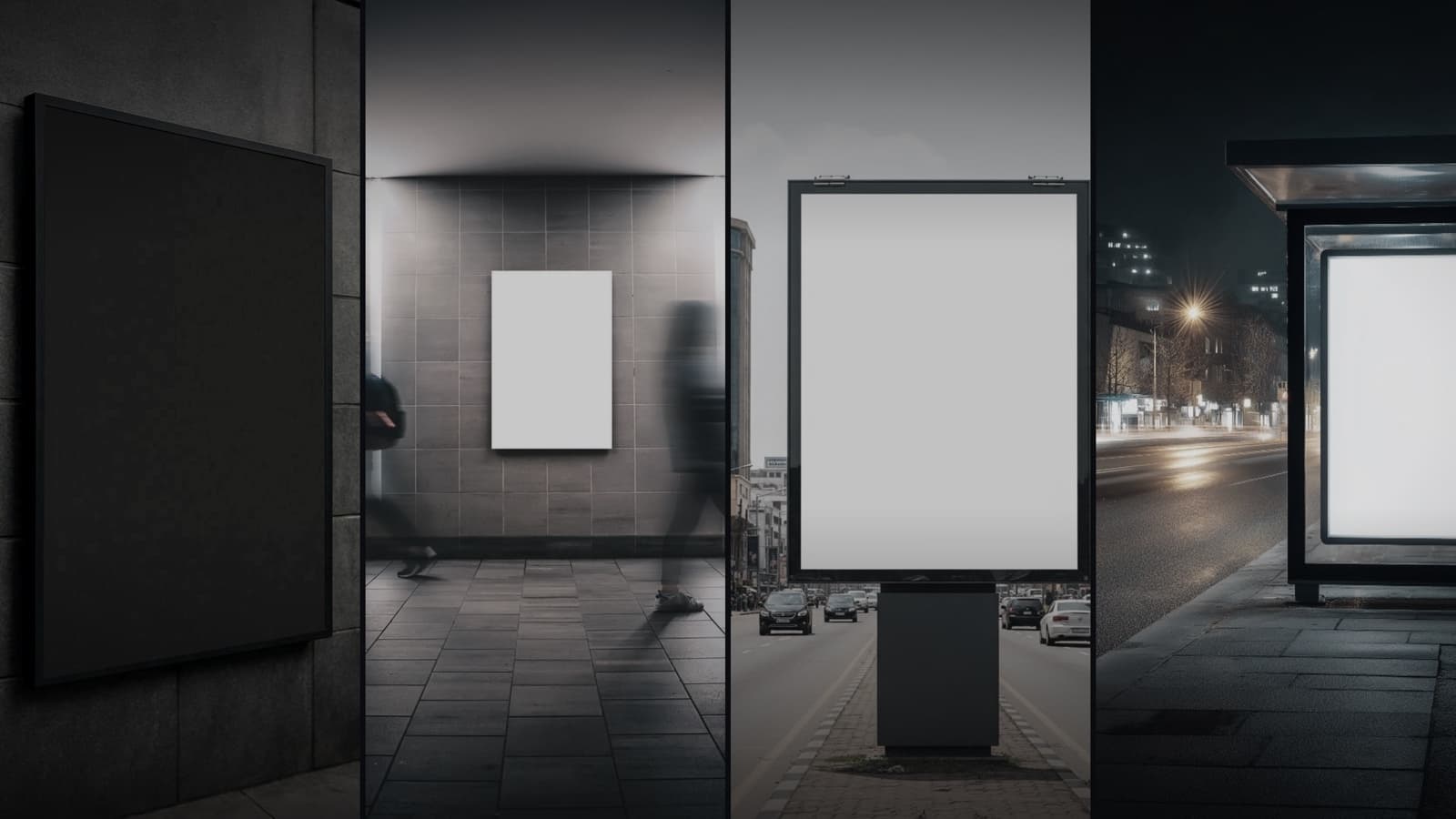
This is the least-discussed fact in digital signage: the hard part was never getting a screen to play. It's getting it to still be playing years later.
Why screens go dark
The failures are boringly consistent. We've walked into enough venues to have a list.
The pen drive
Someone loads a folder of JPEGs onto a USB stick and plugs it into the TV's media player. It works — until the offer changes and nobody wants to find the laptop, remake the file, walk to the screen and swap the stick. The content stays stale for a month, then someone unplugs it, and that's that.
The TV manufacturer's built-in app
Every smart TV ships with some signage or "hotel mode" feature. It is nobody's main product. It gets a firmware update, loses its settings, forgets the schedule, or the model goes out of support and the app is quietly discontinued. There is no one to call.
The cheap software that rotted
This is the most common one, and the most expensive. The player app worked for three months, then started crashing after a power cut, or froze on a black frame, or stopped syncing and kept looping content from January. Somebody restarted it a few times. Eventually the staff decided the screen was "not working" and stopped touching it.
The support that ended at the sale
Not one of the failures above is unfixable. Every one of them is fatal if there's nobody on the other end of the phone. The screen didn't die of a bug — it died of neglect, and the vendor was gone.
A signage product is not what it does on the day you install it. It is what happens on day 400, when something goes wrong and you need someone to care.
Three years, two screens, and nothing to report
We can be specific about this, because our first customer is still running.
The Defence Colony (WA) Club in New Delhi put up its first SLX On Air screen in April 2023. It has been running ever since — and there are two screens there now, both in constant service in a busy members' club.
In more than three years: no software failure that took a screen down for a day. No hardware replacement. No stretch where a screen sat dark while people worked out whose problem it was. Not one bad day.
The only trouble they have ever had was their own internet going down at the club. Even then the screens didn't go dark — they kept playing from their local copy of the content; they simply couldn't receive new updates until the line came back. The moment it did, both screens caught up on their own. Nobody rebooted anything.
That is the complete incident log for three years and two screens. It is not a dramatic story, and that is exactly the point.
“A club runs on notices — events, tournaments, dining specials. Ours are on the screens now, and I change them from my phone. We put the first screen up in April 2023 and it has simply run; the only time it ever gave us trouble was when our own internet line went down, and even then the screens kept playing. We have two screens now. In three years the screens have never let us down.”
They are not the only long-running one. The Vasant Vihar Club has been running SLX On Air for more than two years, on the same platform, with the same support behind it. Two clubs, five years of continuous service between them, and between them a single incident — caused by an internet line, not by us.
The best thing a screen can do is be unremarkable for three years.
What we built so screens don't go dark
Reliability isn't a promise you make in a brochure. It's a set of decisions taken years earlier, each one aimed at a specific way screens die.
A guardian that never sleeps
Every SLX On Air Smart Box runs an independent supervisor process that sits beneath the playback software and starts with the device itself. It watches the player continuously and restarts it automatically if anything goes wrong. This is the single most important thing we ever built: it means the "it crashed and nobody noticed" failure — the one that kills most installations — resolves itself, usually before anyone in the venue looks up.
Offline is a normal state, not an emergency
The box keeps an intelligent local cache of your content and will play for 24 hours or more with no internet at all. Router reboot, ISP outage, someone unplugging the wrong thing in the server cupboard — your screen doesn't care. When the connection returns, it re-syncs silently: new posts in, removed posts out, schedules corrected. Nothing flashes, nothing restarts.
It boots straight to your content
Power cut at 3am? When the power returns, the box comes up and goes directly to your screen — no desktop, no menus, no home screen, no remote control required. There is no state in which a staff member needs to know how to "start" the screen in the morning. The software is embedded at the system level and survives even a factory reset.
It updates itself, carefully
New versions roll out over the air in staged batches, monitored as they go, and install in the background. Nobody visits your site. Nobody clicks anything. This is what stops software rot: the version on your wall is a current, supported one, for five years of software updates from purchase, backed by a 1-year hardware warranty on the box.
It looks after your panel
Displays that run 14 hours a day can burn a static edge into the glass. Elements like the ticker periodically glide off screen for a few seconds — a small motion, invisible in practice, that protects hardware you'll own for years.
Nothing to maintain, on your side
There is no PC in a cupboard, no media player software to update, no Windows machine that needs antivirus, no license key to renew, no IT person required. The screen and the box are the whole installation.
The part nobody asks about until it's too late: after-sales support
Everything above is engineering, and engineering fails eventually. What decides whether your investment is still working in year four is what happens in the hours after it does.
So this is where we've put a disproportionate amount of our attention.
We watch every screen, all the time
Fleet health telemetry runs 24×7 across every SLX On Air display — playback health, connectivity, device condition. Our engineers usually learn that something is wrong from a dashboard, not from you. A meaningful share of issues are found and resolved remotely before anyone at the venue notices anything happened. You should never be our monitoring system.
A person, on WhatsApp
When you do need us, you reach a human being — on the same WhatsApp number you already have, not a ticket portal with a reference number and a survey afterwards. Our commitment is simple: a serious issue — a screen that isn't playing — gets our engineers on it the same day, and is resolved within hours.
We can fix most things without visiting you
Our support team can act on a box remotely — restart the player, reboot the device, refresh content, clear the cache, capture a screenshot of what the screen is currently showing so we can see what you're seeing. That's why problems close in hours rather than on the next site-visit day. And deliberately, that short list is all we can do: the box enforces it and refuses anything else. Remote support that fixes your screen, with a hard limit on what it can reach. See our Security page for exactly where those lines are drawn, including what our own staff can and can't reach.
When you call, we already know the screen
Because every box reports its own health, a support conversation doesn't start with "have you tried switching it off and on again". We can see whether it's online, whether it's playing, when it last synced, and what version it's running before we reply.
And every screen gets the same watch
The two clubs above aren't monitored more closely because we like quoting them — five clubs across Delhi-NCR run on SLX On Air today, alongside hospitals, cafés, clinics, coworking spaces and places of worship, and every one of those screens reports its own health to the same dashboards, around the clock. The oldest installation and the one that went live last week are looked after identically.
A screen that's easy to update is a screen that stays on
There's a quieter reason signage goes dark, and it isn't technical at all: if updating the screen is a chore, nobody updates it — and a screen showing last season's offer gets switched off out of embarrassment.
So the update path has to be trivial, or the reliability engineering underneath it is wasted.
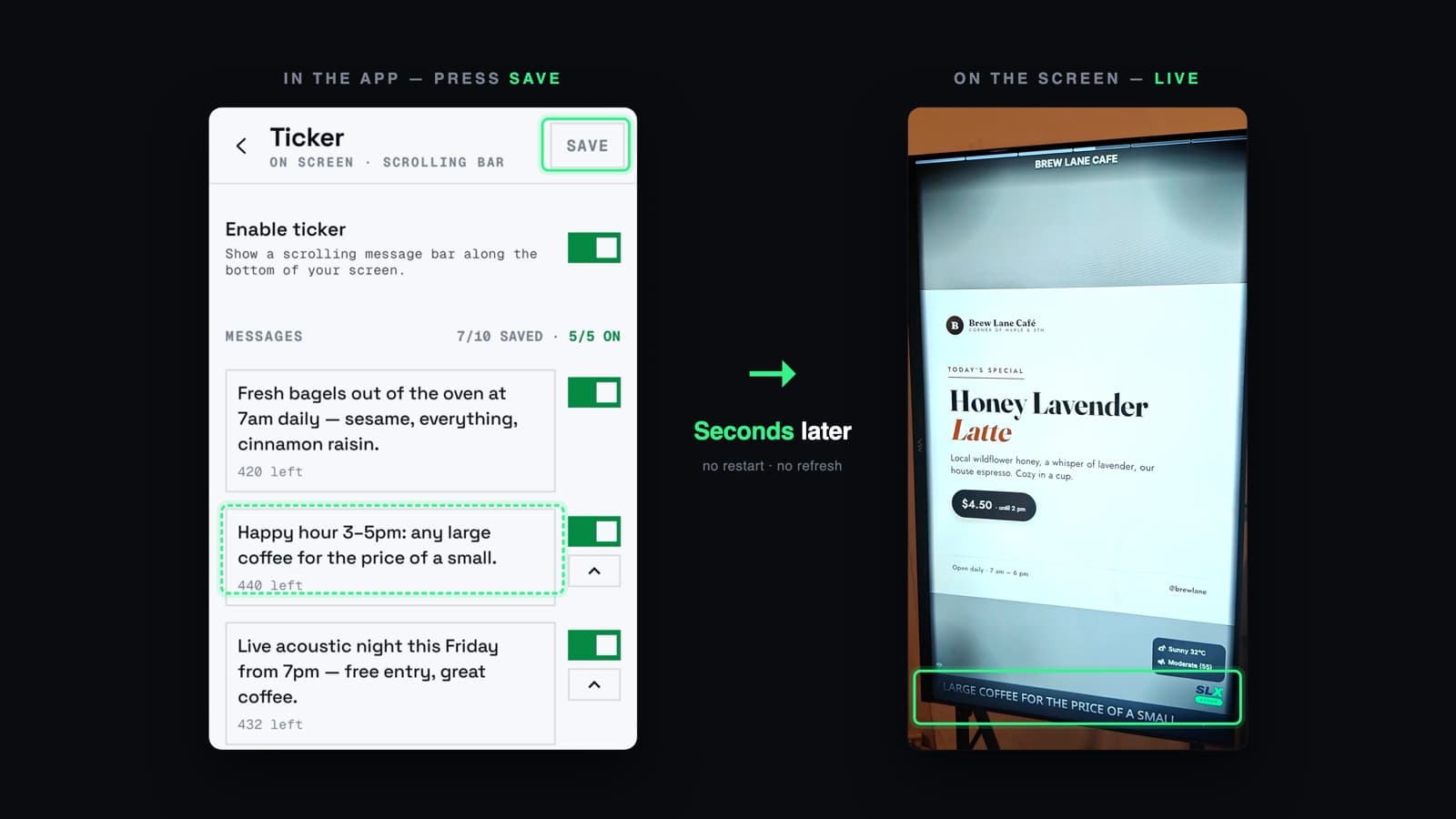
- Post from your phone, live in seconds. Change a price, swap a poster, put up today's special — press save and watch the wall. No restart, no refresh, no "it'll pick it up overnight."
- Schedule it and forget it. Set a go-live time and an expiry. The breakfast offer comes up at 7am and takes itself down at 11, whether or not anyone remembered.
- Reorder with a drag. Move the new arrival to the front of the loop in two seconds.
- Bring whatever you have. Photos, video, PDFs, audio — a PDF menu auto-paginates into proper slides, videos are re-mastered for the big screen with their volume levelled, and images are optimised automatically. No design software, no format rules, no black bars.
- Run it from anywhere. Phone on the way to work, web console at your desk — same screen, same content, always in sync. One person can run screens in five locations without leaving their chair.
Before you buy any screen system, ask these eight questions
Whether you end up with us or not, this is the list we'd use. Most of the industry answers badly.
- 1What happens when the internet goes down?(Right answer: it keeps playing for at least a day and re-syncs itself.)
- 2What happens after a power cut, at 3am, with nobody in the building?(It comes back to content on its own — nobody touches a remote.)
- 3If the player app crashes, what restarts it?(Something independent of the app itself.)
- 4How do you know my screen has stopped playing — do I have to tell you?(They should know first.)
- 5Can you fix it without coming to my site, and how long does that take?
- 6How long will this software be updated for, and who pays for the updates?
- 7How long does it take me to change what's on the screen, from where I'm standing right now?
- 8Show me a customer who has been running this for three years or more.
That last one is the whole test. Anyone can demo a screen. Ask who's still playing.
The commitments, in plain terms
- 5 years of software updates, delivered over the air, included.
- 1-year hardware warranty on the Smart Box.
- Day-credit plans that never expire and are refundable — you're not locked into a monthly subscription for a screen you might pause.
- 21-day return window from activation, if it isn't for you.
- A one-time Smart Box, then day credits — current pricing is on our website.
No PC, no server, no annual license, no IT contract.
Already have a dark screen on your wall?
Then you've done the expensive part. The bracket is up, the cable is run, the panel works. What failed was the software behind it and the support behind that.
An SLX On Air Smart Box plugs into the HDMI port that's already there, and you'll be playing your own content in under five minutes — run from your phone, updated in seconds, watched over by us for as long as it's on your wall.
Send us a photo of the screen that stopped working. We'll tell you honestly whether we can bring it back.
WhatsApp +91 99102 77891 or +91 79767 06738 — or visit simplylocalx.com to put your business on air.